There is no distance at which 8x42 binoculars stop working - you can see a mountain fifty miles away with them. The useful question is what you can tell at a given range. With a good 8x42 in decent light you can detect a deer-sized animal at well over a mile, identify it as a deer at roughly 600-800 yards, and judge antlers out to perhaps 300-400 yards. Past that you need more magnification or a spotting scope.
Detect, identify, judge - three different distances
Hunters ask "how far can you see" and mean one of three things. Separating them is the whole answer.
| Task | What it means | Rough 8x42 range |
|---|---|---|
| Detect | Something is there - an animal-shaped object or movement | Well past a mile in open country |
| Identify | It is a deer, and whether it carries antlers at all | 600-800 yards |
| Judge | Counting points, assessing mass, deciding to stalk | 300-400 yards |
| Judge finely | Scoring, aging, comparing two animals | Not an 8x42 task - use a spotting scope |
These are working ranges for quality glass in good light, not guarantees. Heat shimmer, flat light, rain and the animal's contrast against its background all move them, sometimes by half.
Two things dominate those numbers and neither is magnification. The first is atmospheric conditions: on a hot afternoon, heat shimmer will limit a 15x56 to less than what an 8x42 does at dawn. The second is contrast - a dark elk on a grass slope is visible at twice the distance of a gray mule deer in gray sage.
Why 8x42 sees more than its reach suggests
- A 5.25 mm exit pupil. Divide the objective by the magnification: 42 divided by 8 is 5.25 mm, against 4.2 mm for a 10x42. In failing light that is a visibly brighter image from identical glass, and the maths is in exit pupil and twilight factor.
- A 409 ft field at 1,000 yards. The Viper HD 8x42's published field is 68 ft wider than the 10x42's. More ground per sweep means fewer animals hiding in the gaps between sweeps.
- Less shake. Handshake is magnified along with the image. An 8x shows you less of your own pulse than a 10x, so the image you are studying is steadier and you can study it for longer.
- Less eye fatigue. A brighter, steadier, wider view is less work. Over a four-hour sit, that is more time actually looking.
Put those together and the practical result is that an 8x42 often finds more animals than a 10x42 in cover and in poor light, while the 10x42 tells you more about the animals once found. That is the trade, and it is covered in full in 8x42 vs 10x42.
Quick picks
Ranked by the criteria published on how we review. Tap any row for the full write-up, or go straight to the current price.
| # | Product | Best for | Score | Price |
|---|---|---|---|---|
| 1 | 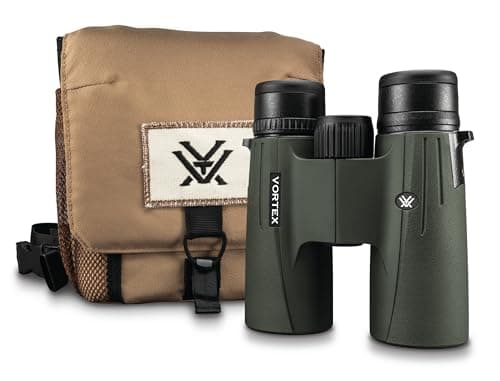 Vortex Viper HD 8x42409 ft of published field, a 5.25 mm exit pupil and 18.0 mm of eye relief - what a good 8x42 looks like. | The reference 8x42Last light and timber | 9.8out of 10 | |
| 2 | 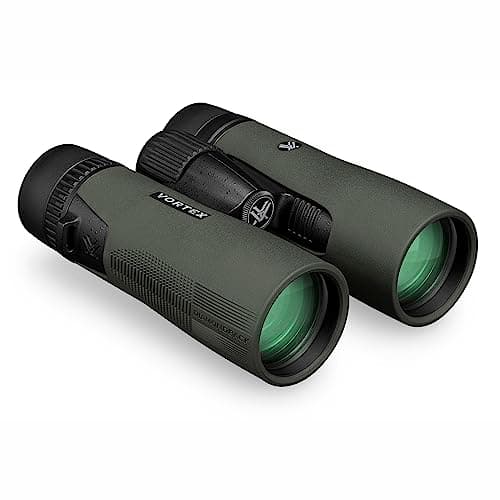 Vortex Diamondback HD 8x42A 5.25 mm exit pupil and 17 mm of eye relief at the entry tier, with a 393 ft field. | Same configuration for lessBudget low-light pick | 9.6out of 10 | See today's price on the Diamondback HD 8x42Check price on Amazon No buyable offer at the last price check. |
| 3 | 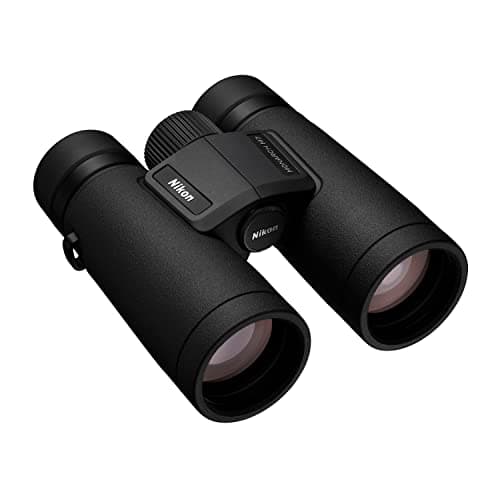 Nikon Monarch M7 8x42ED glass and Nikon's wide-field design in the 8x42 configuration. | Widest viewThe widest field in the format | 9.6out of 10 |
Prices are pulled live from Amazon and were last checked November 12, 2026; if a figure cannot be verified the button reads "Check price" instead. Scores are our editorial judgment against the published ranking criteria, on our published 8.4 to 9.8 recommendation scale. #ad How we earn.
When 8x42 is not enough
- Judging antlers past about 400 yards. The detail is not there. Go to 10x, 12x or a spotting scope.
- Open western country. Sage and basin hunting is a judging problem at distance - see best binoculars for western hunting.
- Tripod glassing. If you are going to sit behind a tripod, the shake argument for 8x disappears and higher magnification wins. How far can you see with 10x42 binoculars covers the next step up.
- Counting points on a bedded animal. That is spotting scope work - see do you need a spotting scope.
How to see further with the binocular you own
Put it on a tripod. This is not a small effect: a braced 8x42 resolves noticeably more detail than a handheld one, because you are no longer averaging the image over your own movement. A tripod adapter costs a fraction of a glass upgrade and is the cheapest way to extend your effective range - the detail is in how to mount binoculars on a tripod.
The second fix is technique. Glassing in a grid, sitting still, and giving each sector real time finds animals that fast panning walks past, regardless of magnification - how to glass for deer covers the method.
Questions people actually ask
How far can you see with 8x42 binoculars?
Is 8x42 enough magnification for hunting?
What does 8x42 mean?
Can you see 1,000 yards with 8x42 binoculars?
Sources
- Vortex Viper HD 8x42 published specifications - read 2026-10-17
- Vortex Diamondback HD 8x42 published specifications - read 2026-10-17