One rule matters more than everything else on this page: never wipe a dry lens. Dust and grit under a cloth act as an abrasive, and the fine scratches they leave in the anti-reflective coatings are permanent. That is how most good binoculars end up slightly hazy.
What you need
- A blower bulb, or a can of compressed air used carefully
- A soft brush (a lens pen or a clean makeup brush)
- Wipes or fluid formulated for coated optics
- A microfiber cloth kept in a sealed bag, not loose in a pocket
- 1
Blow the loose material off first, and touch nothing
A blower bulb, or compressed air held upright and at a distance so no propellant comes out. This step removes the grit that would otherwise be dragged across the coating, and it is the step that actually prevents damage. Do it before anything touches the glass.
- 2
Brush off what the air did not move
A soft brush, light strokes, from the center outwards. You are still not applying pressure. If something is stuck on, it is a job for step 3, not for harder brushing.
- 3
Wet the lens before you wipe it
Use a pre-moistened wipe made for coated optics, or a drop or two of lens fluid on a microfiber cloth - never fluid straight onto the lens, where it can run into the housing. Breath works in the field if you have nothing else; it is not ideal because of what is in it, and it is far better than wiping dry.
- 4
Wipe in a light spiral from the center out
Minimal pressure. A spiral from the center outwards carries material off the edge rather than around the lens. One pass, then check. Repeat with a clean part of the cloth rather than going over the same area harder.
- 5
Dry with a clean part of the cloth, and let it air
Blot rather than scrub. If there is still a smear, that is usually residue rather than dirt - a second wipe with a fresh cloth clears it. Let the binocular dry fully before putting the covers back on, or you trap moisture against the glass.
What never to use
- A shirt tail, a sleeve, or a bandana. The classic mistake. The fabric is abrasive and it is carrying the grit from everything else it has touched.
- Paper towel, tissue or napkins. Wood fiber is harder than you think and it scratches coatings.
- Glass cleaner, window spray or anything containing ammonia. It attacks lens coatings and can degrade the seals.
- Alcohol wipes not intended for optics. Some are fine and some strip coatings; without a label saying it is for coated optics, do not risk it.
- Saliva. It is mildly acidic and it leaves a residue that attracts dirt.
- Pressure. If something will not come off with a light wet wipe, it needs more fluid and more patience, not more force.
The other half: the housing
Easy to forget and genuinely useful. Grit in the focus wheel makes it stiff and eventually gritty-feeling; grit in the eyecup threads makes the twist-up cups unreliable. Blow those out occasionally and wipe the armor with a damp cloth - not fluid, which can find its way into the mechanism.
Do not open anything. Hunting binoculars are nitrogen or argon purged and O-ring sealed, and that seal is what prevents internal fogging. Removing an eyepiece breaks it, and the fogging that follows is not repairable at home.
Prevention beats cleaning
- Use a harness that closes over the glass. Rain, snow and brush never reach the lenses, so there is nothing to clean. Harness picks.
- Keep the objective covers on in brush. Most harnesses let you leave them tethered.
- Keep your microfiber cloth in a sealed bag. A cloth loose in a pocket collects grit and then you rub that grit on your lenses.
- Carry wipes rather than relying on finding a clean cloth. Individually sealed wipes stay clean indefinitely in a pack.
What you need
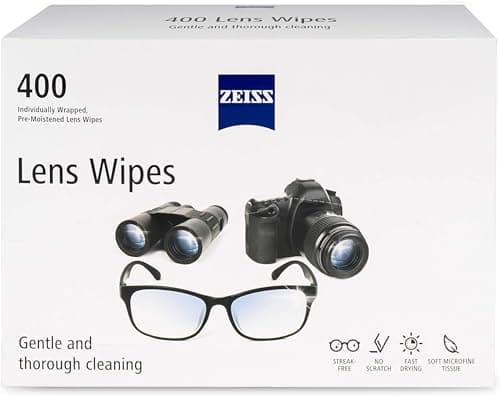
Zeiss Lens Cleaning Wipes for Optics
Pre-moistened wipes formulated for coated optics: the correct answer to the question that otherwise gets answered with a shirt tail.
Magnification and objective are the manufacturer's own model designation; exit pupil and twilight factor are computed from them. We could not machine-read Zeiss's spec page, so the remaining published figures are not listed rather than guessed.
What it does well
- Safe on multi-coated and ED glass
- Individually sealed, so they live in a pack indefinitely
- Cheap enough to keep in every bag
Where it gives ground
- Not a substitute for a blower on grit
- Disposable, so there is ongoing cost
Skip it if
Nothing - everyone with coated glass should own these or an equivalent.
How this score breaks down
- Core function (stability or protection) (weight 5)9.0
- Noise and access speed (weight 4)8.0
- Fit, adjustability and comfort (weight 3)9.0
- Weather protection or build (weight 3)8.0
- Value for money (weight 3)9.5
Weights and definitions are published on how we review. These are editorial judgments from published specs and documented consensus, not test results.
Individually sealed, safe on multi-coated and ED glass, and cheap enough to keep a handful in every pack and the truck. The correct answer to the question that otherwise gets answered with a shirt tail.
Price as of October 5, 2026. #ad How we earn
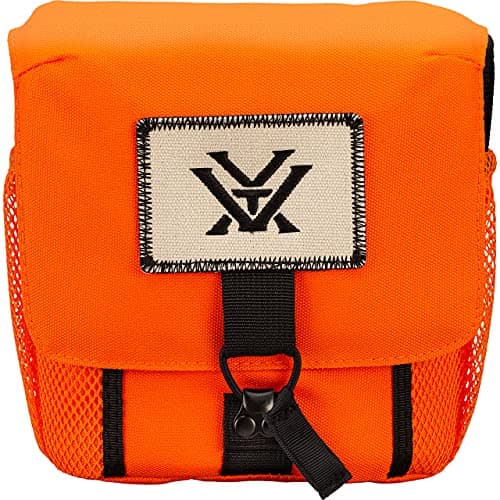
Vortex GlassPak Binocular Harness
At $29 this is the default: it holds the binoculars against your chest, closes over them in rain, and costs less than a tank of fuel.
Magnification and objective are the manufacturer's own model designation; exit pupil and twilight factor are computed from them. We could not machine-read Vortex's spec page, so the remaining published figures are not listed rather than guessed.
What it does well
- $29 for a harness that genuinely works
- Fully encloses the binoculars against weather
- VIP warranty
Where it gives ground
- No rangefinder pouch
- Fabric is noisier than premium harnesses
Skip it if
You carry a rangefinder too - get the Pro or a Marsupial.
How this score breaks down
- Core function (stability or protection) (weight 5)8.5
- Noise and access speed (weight 4)6.5
- Fit, adjustability and comfort (weight 3)8.0
- Weather protection or build (weight 3)8.5
- Value for money (weight 3)10.0
Weights and definitions are published on how we review. These are editorial judgments from published specs and documented consensus, not test results.
The best lens cleaning is the cleaning you do not have to do. A closed harness keeps rain, snow and brush off the glass in the first place.
Price as of October 5, 2026. #ad How we earn
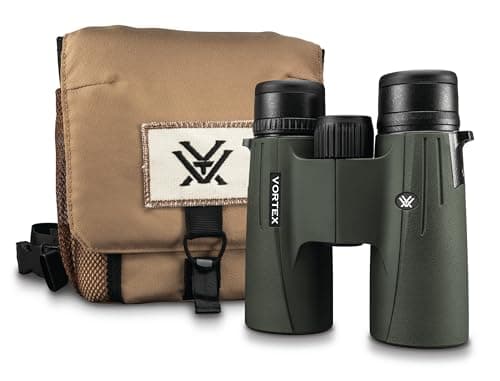
Vortex Viper HD 10x42
The default answer when someone outgrows a $150 pair: 17 mm of eye relief, a 341 ft field of view and glass that holds its edges, at the price where diminishing returns start.
| Magnification | 10x |
|---|---|
| Objective lens | 42 mm |
| Eye relief | 17.0mm |
| Field of view | 341' @ 1000 yds |
| Angular field of view | 6.5º |
| Close focus | 6.0' |
| Weight | 24.9 oz. |
| Height | 5.6" |
| Width | 4.9" |
| Exit pupil (computed) | 4.2 mm |
| Twilight factor (computed) | 20.5 |
Specs verified 2026-10-05 from Vortex's published specification. Exit pupil and twilight factor are computed, not quoted.
What it does well
- 17.0 mm eye relief is generous enough for most glasses wearers
- 341 ft at 1,000 yards is a wide field for a 10x
- Vortex VIP warranty is unconditional and transferable
Where it gives ground
- 24.9 oz is noticeable on a chest harness over a long day
- The 12x50 costs little more if you glass open country
Skip it if
You hunt timber inside 200 yards - the 8x42 Diamondback does that job for less than half the money.
How this score breaks down
- Core function (stability or protection) (weight 5)n/a
- Noise and access speed (weight 4)n/a
- Fit, adjustability and comfort (weight 3)n/a
- Weather protection or build (weight 3)n/a
- Value for money (weight 3)n/a
Weights and definitions are published on how we review. These are editorial judgments from published specs and documented consensus, not test results.
Vortex lists ArmorTek - an ultra-hard scratch-resistant coating on the exterior lenses - among this model's features. Resistant is not immune, and the coatings underneath are what gives you the light transmission you paid for.
Questions people actually ask
What is the best way to clean binocular lenses?
Can I use my shirt to clean binocular lenses?
Can I use glass cleaner on binoculars?
How do I stop my binoculars fogging internally?
Sources
- Vortex Viper HD 10x42 published specifications and feature list - read 2026-10-05