There are four ways people carry binoculars and only one of them is right, which makes this a short page with a clear answer.
The four options
| Method | Weight distribution | Swings when you bend | Protects the lenses | Access speed |
|---|---|---|---|---|
| Neck strap | All on your neck | Badly | No | Fast |
| In the pack | Good | No | Yes | Very slow - so you stop using them |
| In a jacket pocket | Fine | No | Partly | Slow and noisy |
| Harness | Across both shoulders | No | Yes | Fast |
| Harness with a pouch | Across both shoulders | No | Yes | Fast, for two optics |
Why the neck strap loses
Swinging. The strap pivots at your neck, so every time you bend forward - climbing, crossing a fence, leaning out of a stand - the binocular swings away from your body and then back into your sternum. Walking downhill it does this continuously, and on a stand it bangs the rail at exactly the wrong moment.
Exposure. The glass hangs open to rain, snow and brush. A harness with a cover means the lenses are clean when you lift them, which sounds minor until you have spent a wet morning wiping a lens with a damp sleeve.
Neck load. A 25 oz binocular on a strap puts 25 oz on your cervical spine. Across both shoulders, the same weight is barely noticeable. Over a ten-hour day that is the difference between carrying binoculars and resenting them.
And why the pack is worse than it sounds
Putting binoculars in the pack solves the comfort problem by removing the binoculars from the hunt. If getting them out takes thirty seconds and some noise, you will not do it for a quick check - and a quick check is most of what binoculars are for. The optic you cannot reach in two seconds is an optic you do not use.
Once you carry two optics
Most hunters end up carrying binoculars and a rangefinder, and the same logic applies to the second item: a rangefinder in a jacket pocket does not get used at the moment it matters, because reaching it means unzipping and moving with an animal watching.
Two sensible routes. An all-in-one harness with a rangefinder pouch built in, from about $66. Or a modular platform where you bolt pouches on as your kit changes, from about $158 all in. The comparison.
Four practical details that make a harness better
- Set the height so the binocular sits just below your sternum. Too high and it interferes with shouldering a rifle; too low and it swings off your belly when you bend.
- Adjust it over your actual hunting layers. A harness set up over a t-shirt in October is useless over a parka in December.
- Keep the cover out of the way when open. A flap that falls back over the lenses is a small daily irritation that compounds.
- Run the rangefinder pouch on your dominant-hand side. Reaching across your chest while holding binoculars defeats the point.
Three harnesses for three situations
Price as of October 5, 2026. #ad How we earn
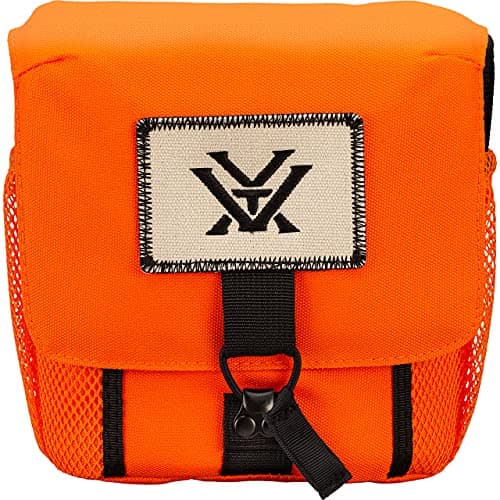
Vortex GlassPak Binocular Harness
At $29 this is the default: it holds the binoculars against your chest, closes over them in rain, and costs less than a tank of fuel.
Magnification and objective are the manufacturer's own model designation; exit pupil and twilight factor are computed from them. We could not machine-read Vortex's spec page, so the remaining published figures are not listed rather than guessed.
What it does well
- $29 for a harness that genuinely works
- Fully encloses the binoculars against weather
- VIP warranty
Where it gives ground
- No rangefinder pouch
- Fabric is noisier than premium harnesses
Skip it if
You carry a rangefinder too - get the Pro or a Marsupial.
How this score breaks down
- Core function (stability or protection) (weight 5)8.5
- Noise and access speed (weight 4)6.5
- Fit, adjustability and comfort (weight 3)8.0
- Weather protection or build (weight 3)8.5
- Value for money (weight 3)10.0
Weights and definitions are published on how we review. These are editorial judgments from published specs and documented consensus, not test results.
The cheapest thing on this site that changes how you hunt.
Price as of October 5, 2026. #ad How we earn
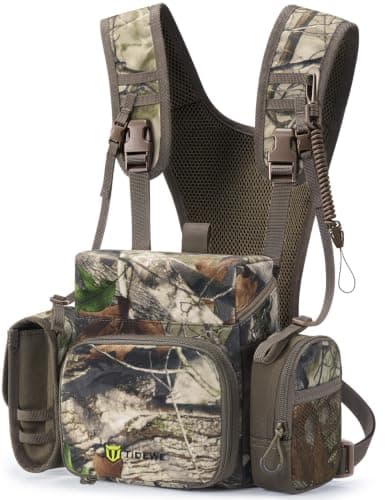
TIDEWE Binocular Harness
A harness with a rangefinder pouch at $66, which is the cheapest way to carry two optics properly.
Magnification and objective are the manufacturer's own model designation; exit pupil and twilight factor are computed from them. We could not machine-read TIDEWE's spec page, so the remaining published figures are not listed rather than guessed.
What it does well
- Includes a rangefinder pouch at the price
- Adjustable straps fit over bulky layers
- Fully enclosing weather flap
Where it gives ground
- Fabric is noisy
- Hardware is not to premium standards
Skip it if
You hunt close-quarters whitetail where noise decides the hunt.
How this score breaks down
- Core function (stability or protection) (weight 5)8.0
- Noise and access speed (weight 4)6.0
- Fit, adjustability and comfort (weight 3)7.5
- Weather protection or build (weight 3)8.0
- Value for money (weight 3)9.0
Weights and definitions are published on how we review. These are editorial judgments from published specs and documented consensus, not test results.
Two optics on your chest for $66, which is the configuration most hunters end up wanting.
Price as of October 5, 2026. #ad How we earn
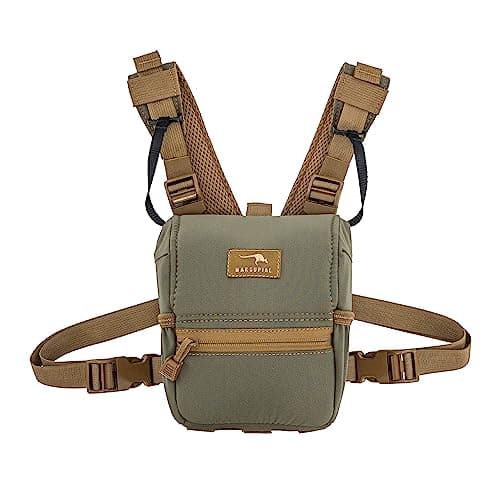
Marsupial Gear Bino Harness
The magnetic closure is the point: it opens and closes silently, which matters when an animal is at 80 yards and looking your way.
Magnification and objective are the manufacturer's own model designation; exit pupil and twilight factor are computed from them. We could not machine-read Marsupial Gear's spec page, so the remaining published figures are not listed rather than guessed.
What it does well
- Magnetic closure is genuinely silent
- Soft fabric does not rasp against brush
- Made in the US with a strong reputation among western hunters
Where it gives ground
- Five times the price of a GlassPak
- Magnets hold less securely than a zip in heavy brush
Skip it if
Budget is the constraint. The GlassPak works.
How this score breaks down
- Core function (stability or protection) (weight 5)9.0
- Noise and access speed (weight 4)9.5
- Fit, adjustability and comfort (weight 3)9.0
- Weather protection or build (weight 3)8.0
- Value for money (weight 3)7.5
Weights and definitions are published on how we review. These are editorial judgments from published specs and documented consensus, not test results.
Worth it for close-quarters whitetail, not worth it if you glass open country at 600 yards.
Questions people actually ask
What is the best way to carry binoculars hunting?
Should I carry binoculars in my pack?
How should a bino harness be adjusted?
Where should I carry my rangefinder?
Sources
- Vortex GlassPak binocular harness product page - read 2026-10-05