We earn a commission if you buy through the links on this page, at no extra cost to you. It never changes which products we pick or how we rank them - read the full disclosure.
Our top pick
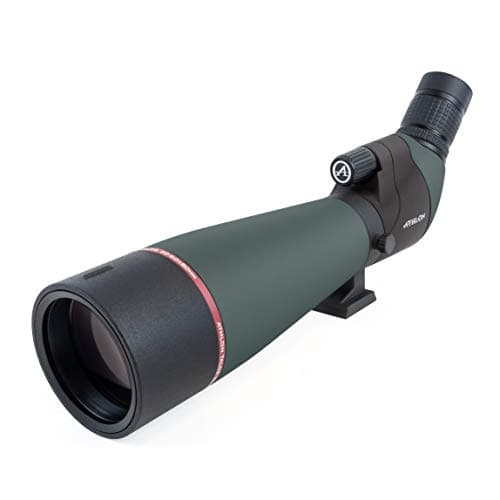
Athlon Talos 20-60x80
An 80 mm objective for around $140 - the point where a spotting scope costs less than the tripod it needs.
Price as of October 5, 2026. #ad How we earn
The useful thing to say about a budget spotting scope is what it cannot do, because the specification implies capability it does not have.
What a $140 to $270 scope genuinely cannot do
- Deliver a usable image above about 40x. The dial goes to 60x; the glass does not. Above 40x you get a bigger, dimmer, softer image that tells you less than 30x did.
- Judge antler detail at long range. Scoring a buck at 900 yards needs resolution this tier does not have at any setting.
- Work at dawn at high magnification. An 80 mm at 40x computes to 2.00 mm of exit pupil. That is dim, and it is arithmetic.
- Survive serious backcountry abuse. These are not sealed and built to the standard of hunting-first scopes at three times the price.
What it can do, which is more than people expect
Confirm what your binoculars found. Check whether that shape at 500 yards has antlers. Watch a hillside at 25x for an hour in comfort. Spot bullet holes on paper at 200 yards. For all of those, a $140 80 mm scope at 25x is a genuinely good instrument, and it costs less than the tripod it should sit on.
Quick picks
Ranked by the criteria published on how we review. Tap any row for the full write-up, or go straight to the current price.
| # | Product | Best for | Score | Price |
|---|---|---|---|---|
| 1 | Athlon Talos 20-60x80An 80 mm objective for about $140 with a lifetime warranty. | Best budget pickCheapest usable spotting scope | 6.3out of 10 | |
| 2 | 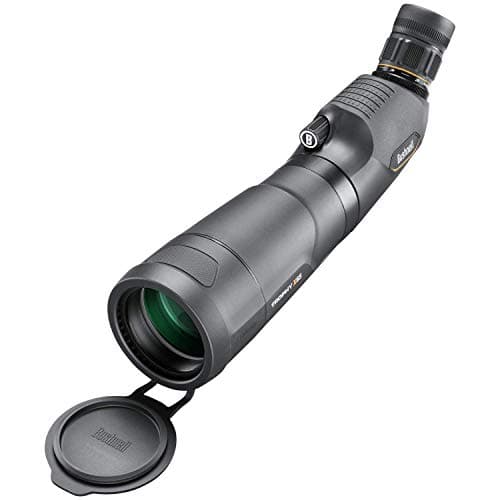 Bushnell Trophy Xtreme 20-60x65A 65 mm scope with a tripod included, about $228. | Best complete setupBudget packable scope | 7.1out of 10 | |
| 3 | 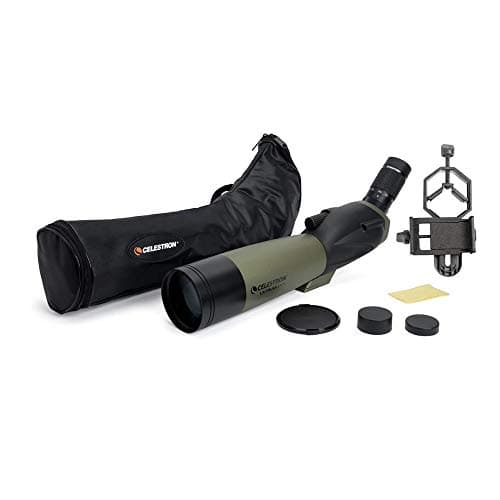 Celestron Ultima 80Published exit pupil figures and a 45-degree eyepiece, about $270. | Best for the rangeTarget shooting and range use | 6.8out of 10 | |
| 4 | 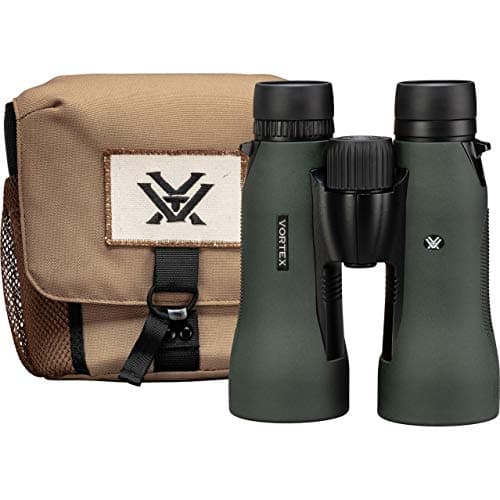 Vortex Diamondback HD 15x5615x56 binoculars on a tripod, about $369, two eyes. | The alternative worth consideringTripod glassing without a spotting scope | 7.4out of 10 |
Prices are pulled live from Amazon and were last checked October 5, 2026; if a figure cannot be verified the button reads "Check price" instead. Scores are our editorial judgment against the published ranking criteria, not a test result. #ad How we earn.
The 15x56 binocular alternative
This deserves its own section, because at this budget it is often the better answer and almost nobody suggests it.
| Athlon Talos 20-60x80 | Vortex Diamondback HD 15x56 | |
|---|---|---|
| Rough price | $140 | $369 |
| Computed exit pupil | 4.00 mm at 20x, 2.00 mm at 40x | 3.73 mm, fixed |
| Twilight factor | 40.0 at 20x | 29.0 |
| Viewing | One eye | Two eyes - far less fatiguing |
| Usable magnification | To about 40x | 15x, all of it |
| Weight | Heavy | 42.7 oz |
| Resolving antler past 600 yd | Possible at 40x | No |
| Comfort over an hour | Moderate | Much better |
Twilight factor computed as the square root of magnification times objective; exit pupil as objective divided by magnification.
Two eyes matter more than most specification comparisons admit. Glassing for an hour through one eye is tiring in a way that compounds, and the binocular's two-eyed view is also better at resolving low-contrast shapes because your brain combines two images.
If your glassing is inside 600 yards, 15x56 binoculars on a tripod are probably the better buy. Past that, the scope's magnification wins. The full comparison.
The picks in detail
Price as of October 5, 2026. #ad How we earn
Athlon Talos 20-60x80
An 80 mm objective for around $140 - the point where a spotting scope costs less than the tripod it needs.
| Magnification | 20x |
|---|---|
| Objective lens | 80 mm |
| Exit pupil (computed) | 4 mm |
| Twilight factor (computed) | 40 |
Magnification and objective are the manufacturer's own model designation; exit pupil and twilight factor are computed from them. We could not machine-read Athlon's spec page, so the remaining published figures are not listed rather than guessed.
What it does well
- 80 mm objective at an entry price
- Includes a basic tripod in most listings
- Lifetime warranty
Where it gives ground
- Image degrades sharply above 40x
- Not built for hard backcountry use
Skip it if
You will judge antler at long range - the resolution is not there.
How this score breaks down
- Resolution at top magnification (weight 5)5.5
- Usable magnification range (weight 4)7.0
- Eye relief across the zoom (weight 3)7.0
- Weight and packability (weight 3)6.0
- Build and sealing (weight 2)6.5
Weights and definitions are published on how we review. These are editorial judgments from published specs and documented consensus, not test results.
The aperture at the price is the reason. 80 mm computes to 4.00 mm of exit pupil at 20x, which is genuinely workable - the limit is glass quality rather than light gathering.
Price as of October 5, 2026. #ad How we earn
Bushnell Trophy Xtreme 20-60x65
A 65 mm objective at around $228 with a tripod included, which makes it the cheapest complete glassing setup here.
| Magnification | 20x |
|---|---|
| Objective lens | 65 mm |
| Exit pupil (computed) | 3.25 mm |
| Twilight factor (computed) | 36.1 |
Magnification and objective are the manufacturer's own model designation; exit pupil and twilight factor are computed from them. We could not machine-read Bushnell's spec page, so the remaining published figures are not listed rather than guessed.
What it does well
- Tripod included in the listing
- 65 mm is light enough to carry
- Fully multi-coated with EXO barrier
Where it gives ground
- The included tripod is the weak link above 40x
- 65 mm limits low-light judging
Skip it if
You already own a tripod - put the money into better glass.
How this score breaks down
- Resolution at top magnification (weight 5)6.5
- Usable magnification range (weight 4)7.5
- Eye relief across the zoom (weight 3)7.0
- Weight and packability (weight 3)8.0
- Build and sealing (weight 2)7.0
Weights and definitions are published on how we review. These are editorial judgments from published specs and documented consensus, not test results.
For someone who owns no tripod, this is the cheapest route to actually glassing. EXO barrier coating sheds water well.
Price as of October 5, 2026. #ad How we earn
Celestron Ultima 80
A 45-degree 80 mm scope with published exit pupil figures from 4 mm down to 1.3 mm, aimed at range work more than mountain hunting.
| Magnification | 20x |
|---|---|
| Objective lens | 80 mm |
| Exit pupil (computed) | 4 mm |
| Twilight factor (computed) | 40 |
Magnification and objective are the manufacturer's own model designation; exit pupil and twilight factor are computed from them. We could not machine-read Celestron's spec page, so the remaining published figures are not listed rather than guessed.
What it does well
- Published exit pupil and field figures across the zoom
- 45-degree eyepiece is comfortable for seated range use
- Inexpensive for an 80 mm
Where it gives ground
- Not sealed to hunting standards
- Heavy for its optical quality
Skip it if
You are packing it into the backcountry.
How this score breaks down
- Resolution at top magnification (weight 5)6.5
- Usable magnification range (weight 4)8.0
- Eye relief across the zoom (weight 3)7.5
- Weight and packability (weight 3)5.5
- Build and sealing (weight 2)6.0
Weights and definitions are published on how we review. These are editorial judgments from published specs and documented consensus, not test results.
Celestron publishes exit pupil from 4 mm down to about 1.3 mm across the zoom (verified 2026-10-05) - unusual transparency at this price. Not sealed to hunting standards.
Price as of October 5, 2026. #ad How we earn
Vortex Diamondback HD 15x56
A 3.73 mm exit pupil and 230 ft of field: the cheapest credible way to sit behind a tripod all morning without carrying a spotting scope.
| Magnification | 15x |
|---|---|
| Objective lens | 56 mm |
| Eye relief | 15.6mm |
| Field of view | 230' @ 1000 yds |
| Angular field of view | 4.4º |
| Close focus | 14.0' |
| Weight | 34.8 oz. |
| Height | 7.1" |
| Width | 5.8" |
| Exit pupil (computed) | 3.73 mm |
| Twilight factor (computed) | 29 |
Specs verified 2026-10-05 from Vortex's published specification. Exit pupil and twilight factor are computed, not quoted.
What it does well
- 15x finds animals a 10x walks past
- 56 mm objective keeps it usable at dawn
- Much lighter and cheaper than a spotting scope setup
Where it gives ground
- 42.7 oz and 15x means a tripod is mandatory, not optional
- Too much magnification for timber or still-hunting
Skip it if
This is your only pair of binoculars. 15x is a second optic, not a first one.
How this score breaks down
- Resolution at top magnification (weight 5)7.5
- Usable magnification range (weight 4)6.0
- Eye relief across the zoom (weight 3)7.5
- Weight and packability (weight 3)8.0
- Build and sealing (weight 2)9.0
Weights and definitions are published on how we review. These are editorial judgments from published specs and documented consensus, not test results.
Vortex publishes 230 ft of field and 15.6 mm of eye relief (verified 2026-10-05); the computed exit pupil is 3.73 mm and the twilight factor 29.0. Inside 600 yards this is more pleasant and nearly as capable as a cheap scope.
Questions people actually ask
Are cheap spotting scopes any good?
What is the cheapest usable spotting scope?
Should I buy a cheap spotting scope or 15x56 binoculars?
Do I need to buy a tripod separately?
Sources
- Celestron Ultima 80 published specifications - read 2026-10-05
- Vortex Diamondback HD 15x56 published specifications - read 2026-10-05